LinkedIn recently launched a new feature that allows users to categorise posts and comments as AI slop, helping the platform manage the onslaught of unoriginal AI-generated content and commentary proliferating the feed.
The ‘Seems like AI slop’ button option is now found on each post and comment’s three-dot button menu (where you would go to save a post, copy post links, or report a post).
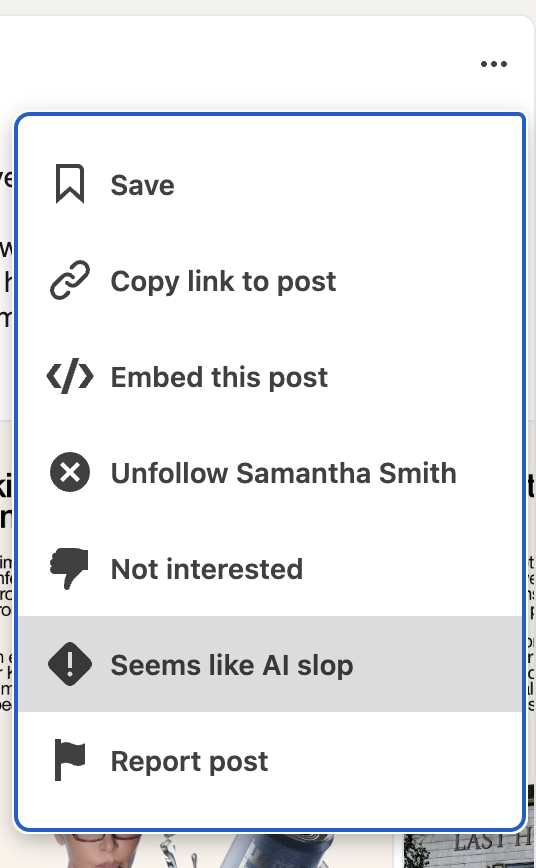
Will this new LinkedIn feature really help with AI slop in the long-run?
Depends who you ask 🫣
There is an argument that it should actually be LinkedIn’s problem. A sophisticated algorithm in 2026 should be able to pick up posts or comments that seem like they’ve been pasted directly from an LLM prompt response in ChatGPT or Claude.
Having said that, the ‘Seems like AI slop’ button will empower people to contribute to the ’cause’, helping weed out profiles that are clearly unoriginal, fake or bots.
And ultimately, this will ensure users stay on the platform and raise those daily active times for LinkedIn. Win-win for them.
About whether it’s going to be of great benefit in the long-run, it may do. The presumption is that currently, the novelty is there and people will use it. But will users lose interest or eventually forget it exists until a blatantly obvious ones crosses their scroll?
Analysing it cynically, there could also be users who abuse this feature, perhaps overusing it and confusing the algorithm with what is and isn’t AI slop.
Time will tell if the LinkedIn feed changes for the better thanks to the ‘Seems like AI slop’ feature. If the feature doesn’t work, and the feed continues to churn out AI slop, there will be a sense of helplessness that even a flag to the algorithm won’t be able to fix.

What does this mean for your LinkedIn content strategy?
With people becoming more aware and discerning about content on any platform, standing out on LinkedIn is vital with this feature in mind. You may be lucky to get away with using AI to generate your content and captions, but leaving the door open for a shred of doubt may impact your post or account performance.
The backbone of social media is authenticity — that’s how it started. Historically, the best performing posts we’ve seen on more or less every platform comes from a personal perspective. Being raw, honest, accountable, vulnerable, authoritative, and your unique kind of funny/sassy/cheeky will always garner more respect, and therefore engagement.
We’ve seen many people try to go down the ‘thought leadership’ route. This may still be a valid avenue for some, but the platform is saturated with wannabe thought leaders thinking they’re the smartest in the room.
You know who isn’t on there? (Warning: this is going to sound very trite.)
You.
→ Need a hand with your brand or personal brand’s strategy on social media?
Here are a few ways to ensure your posts aren’t flagged:
- Ensure your content is original.
Sounds simple, but posts are meant to personal and we have lots of experience working with people where flipping the script from professional to personal increased engagement. Building trust on a personal level can earn you followers and saliency when the time comes. Take time to pour your own thoughts onto the page and you might surprise yourself. - If you are going to use ChatGPT or Claude, edit it.
If you’re not wanting to write posts for yourself — or have a spout of writer’s block — and decide to get AI to help, ensure you don’t just copy and paste as a post. Read and edit to change the tone and choice of words to sound a little more like how you’d say it. And remove all those bloody dashes. - Use AI to help clean up your own work, not own your work.
Using AI platforms to help clean up and tighten your writing come in handy for spelling and grammar errors (especially if you can’t stand plug-ins like Grammarly), making structural changes, ensuring it reads concisely, and even optimising for SEO or other specific functions or channels. Use it as the final clean-up stage, rather than the first step. - Spend time creating prompt templates.
To benefit your strategy long-term, it could be beneficial to spend time curating prompts that you can use for posts ongoing. These can be hyper-specific around your tone of voice, wording choices, native language and colloquialisms, ensuring the responses sound and read like you have written it. This takes time and dedication, and may reduce the likelihood of being dubbed ‘slop’, which none of us want.
Another strategy to work alongside the ‘Seems like AI slop’ feature? Don’t follow anyone that doesn’t share original thoughts.
*And in case you had any doubt: this was written AI-free by Account Manager, Sophie. That Professional Writing & Editing major is going to some use.

